Innovative technology at highly competitive prices.
|
|
ELIT Brand Electrochemical Sensors and Computer-based Instrumentation. Innovative technology at highly competitive prices. |
| HOME | PRODUCTS | TECHNICAL INFORMATION | SITE MAP | CONTACT US | PRICE LIST |
|
Frequently Asked Questions about Ion-Selective Electrode Measurements Full Operating Instructions and basic Theory can be found in our comprehensive Information & Education pages.
1.) What do Ion-Selective Electrodes measure? ISEs measure the activity of free ions in aqueous solutions. Top2.) What is the difference between activity and concentration? Activity is the effective concentration - i.e. that portion of the ions which are free to take part in a given reaction - in this case coming into contact with the membrane surface. Activity is always less than concentration due to inter-ionic interactions in the solution, which inhibit the movement of ions and prevent some of them from reaching the membrane. It becomes proportionately less as the concentration increases. In practice this effect is negligible (within the error limits of the measurement) below about 0.01M for monovalent ions and 0.001M for divalent ions. The difference between activity and concentration is expressed as the Activity Coefficient. Top3.) What is ISAB and when is it used? Ionic Strength Adjustment Buffer is added equally to samples and standards to
minimise any errors due to differences in ionic strength between samples and standards which will cause differences in activity coefficents which can cause the concentration to be understimated by up to 50 or 60% in the worst cases. In some cases ISABs can also include ingredients which minimise
interference effects, and ensure that the pH is optimum for the ISE measurement. Furthermore, for some ions, the addition of ISAB can help to reduce the time required to reach a stable reading after immersing the electrodes in a new solution. The recommended ISAB for each ISE can be found in the electrode specification sheet. However, it must be noted that most ISABs only increase the IS to about 0.1 Molar so will not be effective for samples which already approach this level. In this case there is no point adding more strength to the samples and it is necessary to bring the standards up to the same level by making them with a matrix similar to the samples but not containing the target ion or any that would interfere with it. Alternatively, high Ionic Strength samples can be analysed by the Standard Addition or Sample Addition method. 4.) What is meant by Interference in ISE measurements? Ion-selective electrodes are not completely ion-specific. All are sensitive to some other ions to some extent. The degree of sensitivity to another ion is given by the Selectivity Coefficient, where a value of 0.1 indicates that the electrode is ten times more sensitive to the primary ion than to the interfering ion. A value of 1 indicates equal sensitivity to both ions. 5.) How do I choose the correct reference electrode? The reference electrode outer filling solution, which is in contact with the external test solution, must not contain any ions that will interfere with the ion being detected. The recommended reference electrode can be found in the ISE specification. 6.) Do I need to replace or top-up any electrode filling solutions? All ELIT ISEs are all-solid-state and contain no liquid or gel solutions - so there is nothing to replace. 7.) What can I do about a noisy electrode signal? If the signal is very erratic and jumps by tens or even hundreds of millivolts then this is probably due to minute bubbles in the reference electrode electrolyte. These can develop during transport or prolonged storage. This can normally be cured by holding the electrode firmly with the active tip pointing downwards and shaking down several times with a flick of the wrist, as with old medical mercury thermometers ( i.e. down vigorously but up gently so that the gel is propelled towards the ceramic frit and any bubbles away from it). Large deviations may also be due to poor connections in the wiring or
moisture on the contacts and in this case all connections should be checked and
cleaned. Random deviations of a few millivolts may be due to contamination of
the ISE membrane. 8.) What should I do if the measured electrode slope is outside the specified limits? If the slope is only a few millivolts outside specification but is stable and
reproducible then the ISE can still be used satisfactorily, although the lower
the slope the higher the errors on the measurement of activity (or
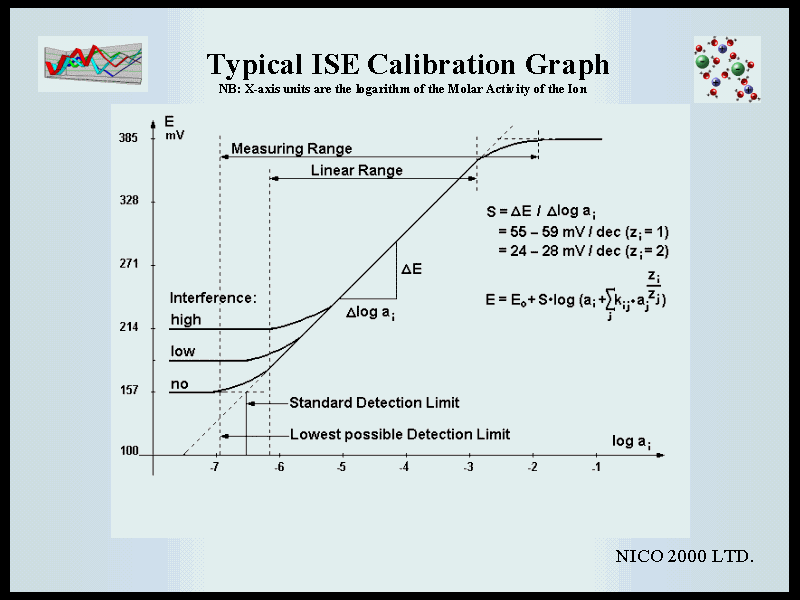
concentration). 9.) How do I clean contaminated membranes? Crystal membranes can be cleaned by washing with alcohol to remove any organic deposits and gently polishing the crystal surface with fine emery paper to remove any obvious markings or discoloration. Then wash with de-ionised water and wipe dry with a low lint tissue, ensuring that no particles are left on the membrane. The crystal surface should be smooth and shiny. PVC membranes must not be abraded, or even touched. These can also be washed in alcohol and then regenerated by soaking in the appropriate 1000 ppm standard solution overnight, or even for several days. They must only be gently dabbed dry after washing (not wiped) to avoid scratching the surface. The ceramic frits at the tips of reference electrodes can also be cleaned with alcohol to remove organic contamination, and soaked in 0.1Molar HCl to remove other deposits. 10.) After immersing the electrodes, how long should I wait before taking a reading? Most electrode systems require about three or four minutes to reach a completely stable reading. Nevertheless, most electrode combinations get to within one or two millivolts of the final value in less than thirty seconds, so it depends on your precision requirements as to whether you wait for complete stabilisation or not. 11.) What precision can I expect from an ISE measurement? Precision is the reproducibility of repeat measurements of the same sample. This is different from accuracy which is how near is the result to the true value. Ideally, results of any experimental measurement should give values that are accurate within the precision limit but this is not always true for ISE measurements. Assuming that there are no variable systematic errors from interference or activity
coefficient effects (which also affect the accuracy), the precision depends on the error in the measurement of the electrode potential (mV) and the slope of the calibration line (mV/decade of concentration). These errors are unlikely to be better than about ± 1 mV and are equivalent to ~4% error in the concentration for monovalent ions (slope~54) and
~8% error for divalent ions (slope~27), when working in the normal linear
range of the electrodes. 12.) What is meant by ‘drift’ in ISE measurements? Drift is the gradual change in electrode response over a period of time. The rate and extent of drift can vary depending on which particular ISE and reference electrodes are being used and the age and degree of contamination of the electrodes. If a series of samples are measured repeatedly it will be observed that each successive reading of the same solution will be slightly different to the previous one. This problem can be overcome by frequently measuring one calibration solution in between sample measurements, then re-calibrating when the mV value has drifted beyond an acceptable level - depending on precision requirements. Once the extent of drift is known then it should be possible to find the optimum time of use or number of samples analysed before a calibration is necessary. 13.) What is the effect of temperature change on ISE measurements ? Unfortunately this is a complicated relationship which cannot be simply quantified in terms of mV change per °C since the effect is different at different concentrations and actual value of the mV. Moreover, the electrode slope, the liquid junction potential, and solubility of the salts in the reference system all vary with temperature. However, the magnitude of the effect of temperature change on the slope can be calculated from a modified form of the Nernst equation (Slope = 2.303RT/nF = T x Constant) to be about 3.4% per 10°C - ie: if the slope is about 55mV/dec then a 10°C rise will increase this to about 57mV/dec. Thus, in order to avoid any errors due to temperature change it is advisable to recalibrate with standards at the same temperature as the sample solutions if the sample temperature deviates by more than about 2°C from the original calibration temperature. 14.) How frequently should I re-calibrate the electrodes? This depends on the precision requirements for the results and the rate of drift of the electrode system. If only an ‘order of magnitude’ measurement is required then it may only be necessary to calibrate once a day or even less frequently. Apart from drift, any large temperature changes (greater than 2°C) will cause a change in the calibration. For the most precise results, it may even be beneficial to calibrate between every sample. 15.) What is the concentration range and detection limit for an ISE measurement? These figures are quite different depending on which ion is being measured. The lowest detection limit is about 0.005ppm for Sulphide ion and the highest about 1ppm for Chloride. The total measuring range for each ISE is given in the individual specification sheets where the lower figure is the detection limit - but note that these limits are necessarily only rough estimates of what is possible since the errors escalate dramatically in the non-linear range as the slope reduces and the detection limit is approached. The best precision can only be achieved in the linear range of the electrode. 16.) How should I store the electrodes between analytical sessions? In general, for overnight or longer storage, ISEs should always be rinsed with de-ionised water and gently dabbed
dry with a low-lint tissue, and the black plastic cap should be replaced to protect the membrane from atmospheric oxidation/corrosion. 17.) What is the shelf life and operating life of an ISE? ELIT Ion Selective Electrodes are exceedingly robust and durable. The shelf life of a new unused solid-state ISE is many years - providing that the protective cap is kept in place to limit any atmospheric corrosion. They are guaranteed for six months during normal operation, but in practice have been found to last much longer than this.
18.) Does the operating life of an ISE depend on the number of samples analysed? ISE operation is based on ion-exchange / charge-transfer principles. Thus there is hardly any consumption of materials or wear and tear on components when samples are analysed. Assuming that the electrode is not exposed to damaging chemicals, the only deterioration is due to the gradual corrosion (oxidation, hydration, leaching) of the membrane, the plastic body, and the adhesive used to attach the membrane to the body (or to physical damage to the membrane surface or to the pin connecting to the electrode head). The extent of the corrosion is dependent on the length of time the electrode is immersed or exposed to the atmosphere rather than the number of samples analysed. Customer experience has shown that electrodes can be immersed continuously for months without deteriorating and, for individual sample measurements with average immersion times of two or three minutes, many thousands of samples can be measured with one electrode. 19.) What range of milliVolt readings can I expect from my ISE ? The measured mV is essentially the potential difference between the membrane potential (generated by the passage of the target ions) and the reference electrode potential. But this is complicated by the fact that there are also contributions from other potential differences that may be generated at any of the metal-metal, metal-liquid or liquid-liquid junctions in the circuit. In the case of All-Solid-State ISEs, one of the internal Junction Potentials is stable but can be hundreds of mV and is different for different ions.
CCR/07/08/03 - Last Update 28 Sept. 2016 |